免费短视频分享大全 - 大中国 免费短视频分享大全 - 大中国
游客
海报背景
1.0
网友评分
  • 很差
  • 较差
  • 还行
  • 推荐
  • 力荐
762次评分
  • 很差
  • 较差
  • 还行
  • 推荐
  • 力荐
扫描观看

扫描一扫app播放

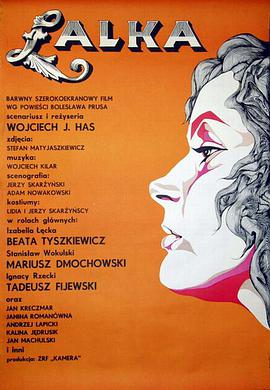
  The Doll is an adaptation of the novel, The Doll (novel) by Bolesław Prus, which is regarded by many as one of the finest Polish novels ever written and, along with Pharaoh (novel), made Bolesław Prus a potential candidate for the Nobel Prize in literature. The influence of Émile Zola is evident, and some have compared the novel to Madame Bovary by Gustave Flaubert; both were Prus's contemporaries. The movie, however, may be more compared to Stendhal's Le Rouge et le Noir, (The Red and the Black).  The Doll constitutes a panorama of life in Warsaw between 1878 and 1879, and at the same time is a subtle story of three generations of Polish idealists, their psychological complications, their involvement in the history of the nineteenth century, social dramas, moral problems and the experience of tragic existence. At the same time this story describes the disintegration of social relationships and the growing separation of a society whose aristocratic elite spreads the models of vanity and idleness. In the bad air of a backward country, anti-Semitic ideas are born, valuable individuals meet obstacles on their way, and scoundrels are successful.  This poetic love story follows a nouveau riche merchant, Stanislaw Wokulski, through a series of trials and tribulations occasioned by his obsessive passion for an aristocratic beauty, Izabela Lecka, played by the famous Polish actress, Beata Tyszkiewicz.  Plot:  As a descendant of an impoverished Polish noble family, young Wokulski is forced to work as a waiter at Hopfer's, a Warsaw restaurant, while dreaming of a life in science. After taking part in the failed 1863 Uprising against Tsarist Russia, he is sentenced to exile in Siberia. On eventual return to Warsaw, he becomes a salesman at Mincel's haberdashery. Marrying the late owner's widow (who eventually dies), he comes into money and uses it to set up a partnership with a Russian merchant he had met while in exile. The two merchants go to Bulgaria during the Russo-Turkish War of 1877-78, and Wokulski makes a fortune supplying the Russian Army. The enterprising Wokulski now proves a romantic at heart, falling in love with Izabela, daughter of the vacuous, bankrupt aristocrat, Tomasz Łęcki. In his quest to win Izabela, Wokulski begins frequenting theatres and aristocratic salons; and to help her financially distressed father, founds a company and sets the aristocrats up as shareholders in his business.The indolence of these aristocrats, who secure with their pensions, are too lazy to undertake new business risks, frustrates Wokulski. His ability to make money is respected but his lack of family and social rank is condescended to. Because of his "help" (in secret) to Izabela's impecunious but influential father, the girl becomes aware of his affection. In the end she consents to accept him, but without true devotion or love.(wikipedia)
展开
无模块

资源列表

排序

相关明星

相关影片

更多
离开军营的日子
王新军 张蓓蓓 潘雨辰 高锦 孙大川 张嘉文涵 刘家良 田琳 封柏 朱家三 普超英
离开军营的日子
王新军 张蓓蓓 潘雨辰 高锦 孙大川 张嘉文涵 刘家良 田琳 封柏 朱家三 普超英
捆绑上天堂
捆绑上天堂2019 / Bound in Heaven
寓言.The Fable
马诺杰·巴杰帕伊 , 普里扬卡·博斯 , 蒂洛塔玛·索姆 , 迪帕克·迪布里亚尔 , Hiral Sidhu , Awan Pookot , Viking , Ravi Bisht
寓言.The Fable
马诺杰·巴杰帕伊 , 普里扬卡·博斯 , 蒂洛塔玛·索姆 , 迪帕克·迪布里亚尔 , Hiral Sidhu , Awan Pookot , Viking , Ravi Bisht
血色残阳 (2005)
赵子琪,贾一平,宋春丽,何赛飞,史可,李立群,修庆,高蓓蓓
血色残阳 (2005)
赵子琪,贾一平,宋春丽,何赛飞,史可,李立群,修庆,高蓓蓓
河湟谣​
二十世纪九十年代,西宁被南北荒山环绕,风沙肆虐。青海机床厂的一群青年——消沉的林明山、执着的黄秋英、憨厚的朱有才、精明的马奔腾,在命运推动下投身绿化工程。他们在高寒干旱中摸索种树良法,经历战友牺牲的悲
河湟谣​
二十世纪九十年代,西宁被南北荒山环绕,风沙肆虐。青海机床厂的一群青年——消沉的林明山、执着的黄秋英、憨厚的朱有才、精明的马奔腾,在命运推动下投身绿化工程。他们在高寒干旱中摸索种树良法,经历战友牺牲的悲
  • 片名:玩偶1968
  • 状态:已完结
  • 主演:马里乌什·德莫霍夫斯基 贝娅塔·蒂希基维茨 菲耶夫斯基·塔德乌什 Jadwiga Gall 维斯拉夫·格拉斯 卡里娜·谢鲁斯克 Jan Koecher 扬·克雷奇马尔 塔德乌什·孔德拉特 Halina Kwiatkowska 安杰伊·瓦皮茨基 扬·马休斯基 Józef Pieracki Janina Romanówna Anna Seniuk Irena Szramowska Wladyslaw Dewoyno 卢德维克·伯努瓦 克雷斯蒂娜.费尔德曼 Aleksander Fogiel Andrzej H 
  • 导演:沃伊切赫·哈斯 
  • 年份:1968
  • 地区:其它
  • 类型:剧情 
  • 频道:内详
  • 上映:未知
  • 语言:其它
  • 更新:2025-06-27 15:44
  • 简介:  The Doll is an adaptation of the novel, The Doll (novel) by Bolesław Prus, which is regarded by many as one of the finest Polish novels ever written and, along with Pharaoh (novel), made Bolesław Prus a potential candidate for the Nobel Prize in literature. The influence of Émile Zola is evident, and some have compared the novel to Madame Bovary by Gustave Flaubert; both were Prus's contemporaries. The movie, however, may be more compared to Stendhal's Le Rouge et le Noir, (The Red and the Black).  The Doll constitutes a panorama of life in Warsaw between 1878 and 1879, and at the same time is a subtle story of three generations of Polish idealists, their psychological complications, their involvement in the history of the nineteenth century, social dramas, moral problems and the experience of tragic existence. At the same time this story describes the disintegration of social relationships and the growing separation of a society whose aristocratic elite spreads the models of vanity and idleness. In the bad air of a backward country, anti-Semitic ideas are born, valuable individuals meet obstacles on their way, and scoundrels are successful.  This poetic love story follows a nouveau riche merchant, Stanislaw Wokulski, through a series of trials and tribulations occasioned by his obsessive passion for an aristocratic beauty, Izabela Lecka, played by the famous Polish actress, Beata Tyszkiewicz.  Plot:  As a descendant of an impoverished Polish noble family, young Wokulski is forced to work as a waiter at Hopfer's, a Warsaw restaurant, while dreaming of a life in science. After taking part in the failed 1863 Uprising against Tsarist Russia, he is sentenced to exile in Siberia. On eventual return to Warsaw, he becomes a salesman at Mincel's haberdashery. Marrying the late owner's widow (who eventually dies), he comes into money and uses it to set up a partnership with a Russian merchant he had met while in exile. The two merchants go to Bulgaria during the Russo-Turkish War of 1877-78, and Wokulski makes a fortune supplying the Russian Army. The enterprising Wokulski now proves a romantic at heart, falling in love with Izabela, daughter of the vacuous, bankrupt aristocrat, Tomasz Łęcki. In his quest to win Izabela, Wokulski begins frequenting theatres and aristocratic salons; and to help her financially distressed father, founds a company and sets the aristocrats up as shareholders in his business.The indolence of these aristocrats, who secure with their pensions, are too lazy to undertake new business risks, frustrates Wokulski. His ability to make money is respected but his lack of family and social rank is condescended to. Because of his "help" (in secret) to Izabela's impecunious but influential father, the girl becomes aware of his affection. In the end she consents to accept him, but without true devotion or love.(wikipedia)
视频
搜索历史
删除
热门搜索
本地记录 云端记录
登录账号